
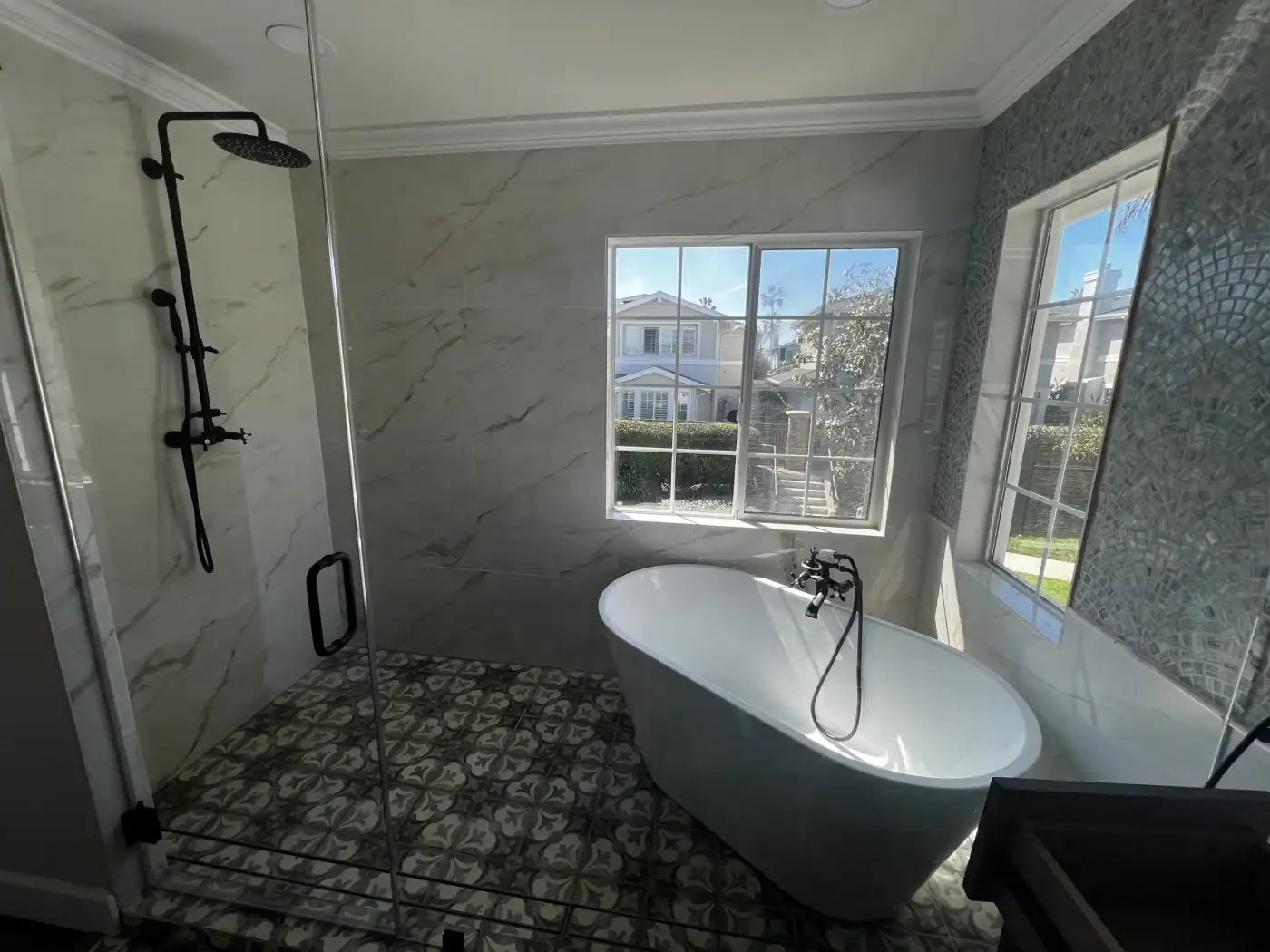
For San Diego homeowners, a reasonable early bathroom vanity installation cost allowance is approximately $1,000 to $3,500 for a straightforward stock or budget replacement, $2,800 to $7,500 for a mid-range project, and $7,000 to $18,000 or more for custom cabinetry, premium countertops, double sinks, significant plumbing changes, or extensive finish repairs.
Stock vanity or vanity-top package, basic sink and faucet, straightforward removal, installation, and reconnection on the same footprint.
Better cabinet, quartz or similar top, new sink and faucet, removal, installation, plumbing, and limited finish work.
Custom cabinet, premium top, two sinks, floating installation, plumbing changes, wall and floor repairs, upgraded lighting or mirror.
These planning ranges combine the vanity, countertop, sink, and faucet allowances published in First Choice Home Builders' 2026 San Diego bathroom remodeling cost guide with national 2026 installation, removal, and connection ranges. They are not a substitute for a site-specific quote. A simple labor-only price can be much lower — national guides commonly place basic installation labor around $200 to $1,000, depending on the vanity, site conditions, and whether plumbing or finish work is included.
This distinction matters. A $400 installation price may cover only setting and securing a ready-to-install cabinet. A $4,000 quote may include the vanity, countertop, sink, faucet, demolition, disposal, plumbing connections, wall repair, backsplash, caulking, and project coordination. Compare scope before comparing totals.
Bathroom Vanity Installation Cost at a Glance
| Project level | Planning range | Typical scope |
|---|---|---|
| Labor-only basic install | $200–$1,000 | Set, level, anchor, and assemble a standard vanity under favorable conditions; plumbing may be separate |
| Budget same-footprint | $1,000–$3,500 | Stock vanity or vanity-top package, basic sink and faucet, straightforward removal, install, and reconnection |
| Mid-range project | $2,800–$7,500 | Better cabinet, quartz or similar top, new sink and faucet, removal, install, plumbing, and limited finish work |
| Premium / custom | $7,000–$18,000+ | Custom cabinet, premium top, two sinks, floating install, plumbing changes, wall/floor repairs, upgraded lighting or mirror |
These are budgeting ranges rather than fixed prices. Vanity width, cabinet construction, countertop fabrication, plumbing alignment, wall condition, access, finish selections, permits, and the company responsible for each trade all affect the final estimate.
Why Online Vanity Cost Estimates Look So Different
Online prices vary because the phrase "vanity installation" can describe several different scopes:
- Cabinet installation only: the vanity is already assembled and the installer positions, levels, and anchors it.
- Cabinet plus plumbing connection: the sink, faucet, supply lines, drain, and P-trap are installed or reconnected.
- Complete replacement: the old unit is removed, the new cabinet and top are installed, plumbing is connected, and debris is hauled away.
- Full vanity package: the contractor supplies the cabinet, top, sink, faucet, mirror, lighting, backsplash, plumbing, and finish repairs.
- Custom remodeling scope: cabinetry and countertop are made to fit, walls or flooring are repaired, plumbing or electrical systems move, and multiple trades are coordinated.
Always ask whether a published range includes materials, labor, plumbing, removal, disposal, tax, delivery, permit fees, and finish repairs.
Bathroom Vanity Cost Breakdown
Vanity Cabinet $200–$3,000+
Stock vanities are made in standard dimensions and finishes and offer the lowest starting price. Semi-custom options provide more sizes, door styles, finishes, and storage configurations. Fully custom cabinets are designed for the exact wall, plumbing, storage needs, and architectural details of the room. Cabinet price depends on width, depth, and number of sink bases; particleboard, MDF, plywood, or solid-wood construction; hardware; finish type; standard versus custom dimensions; freestanding, furniture-style, built-in, or floating construction; and delivery, assembly, and scribing requirements. A low cabinet price can be reasonable for a powder room or rental — but check moisture resistance, drawer construction, hardware, and warranty before deciding on price alone.
Countertop $100–$1,500+
An integrated vanity top can simplify purchasing and installation because the top and sink are packaged for the cabinet. Custom stone or quartz requires templating, fabrication, sink cutouts, edge finishing, delivery, and installation. Common options include cultured marble, laminate, quartz, granite, porcelain slab, natural marble, solid surface, and wood or specialty materials made for bathroom use. Price rises with slab quality, vanity width, thickness, edge profile, backsplash, side splashes, number of sink cutouts, undermount preparation, and difficult delivery access.
Sink & Faucet $150–$700+
An integrated sink generally reduces installation steps. Undermount sinks require a compatible top, accurate fabrication, and a finished cutout; vessel sinks affect counter height, faucet reach, and drain placement. Faucet price varies by brand, valve quality, finish, spread, and mounting holes — and whether the plumbing configuration matches the new selection. Include the drain assembly, supply lines, shutoff valves, and other connection parts when comparing packages.
Installation Labor $200–$1,000
National 2026 cost guides place vanity installation labor within a broad $200-to-$1,000 range. Basic work may include assembling the cabinet, cutting plumbing openings, positioning and leveling it, securing it to framing, installing hardware, and standard setup and cleanup. Labor increases when the vanity is heavy, arrives unassembled, must be scribed to uneven walls, requires extra installers, needs floating support, or includes a field-fabricated countertop. Plumbing, electrical, drywall repair, tile, painting, and disposal may be separate.
Plumbing Connection parts to $2,000+
Reusing the existing sink location is usually the largest cost-control decision. Work becomes more expensive when new cabinet drawers conflict with the drain or supply lines; a center drain must move for an offset sink; a single sink becomes a double; shutoff valves or corroded piping need replacement; the drain height does not suit a floating or vessel vanity; plumbing must move inside a wall or floor; or previous work is unsafe, leaking, or not code-compliant. Ask the contractor to separate ordinary reconnection from wall-opening and pipe-relocation allowances.
Removal & Disposal $115–$500+
Removal price depends on vanity width, countertop weight, wall attachment, plumbing disconnection, stairs, elevator rules, parking, and local disposal requirements. A stone top may require multiple workers and controlled demolition. The old vanity can reveal damaged drywall, missing flooring, unpainted areas, mold, or evidence of a long-term leak — conditions usually outside a basic removal allowance because their extent cannot be confirmed before demolition.
Wall, Floor & Finish Repairs Highly variable
A replacement vanity may not cover the same footprint or wall area as the old unit. Budget for possible drywall patching and texture matching; primer and paint; baseboard or trim changes; flooring infill beneath a smaller vanity; tile or backsplash repair; blocking for a floating vanity; mirror, medicine cabinet, or lighting relocation; and water-damage or mold remediation. Matching discontinued tile or aged flooring can cost more than the small repair area suggests.
Vanity Installation Cost by Project Type
Same-Size Freestanding Replacement
Generally the lowest-cost project: the new cabinet covers the old footprint, plumbing stays in the same position, the top fits without custom fabrication, and the wall and floor are in good condition. Best cost-control choices are to match the existing width and sink centerline, select an assembled vanity with a compatible top, confirm the plumbing clears drawers and shelves, keep the faucet configuration compatible, and inspect the product for damage before the installer arrives.
Floating Vanity Installation
A floating vanity mounts to the wall rather than resting on the floor. It can make the floor easier to clean and create a more open appearance, but installation may require wall blocking, precise anchoring, plumbing relocation, drywall repair, and careful alignment. Do not assume existing drywall anchors are adequate — the vanity, top, sinks, stored items, and people leaning on the counter create substantial load. Support should be designed for the selected unit and wall conditions.
Double Vanity Installation
A double vanity adds a second sink, faucet, drain, and set of supply connections. Cost depends on whether the bathroom already has rough plumbing for two sinks; converting a single vanity normally requires wall access and plumbing work in addition to the longer cabinet and countertop. Two sinks also reduce drawer and cabinet space — a trade-off worth weighing among the master bathroom remodeling ideas before you commit.
Custom Built-In Vanity
Custom cabinetry is useful when the bathroom has unusual dimensions, an angled wall, a specific storage requirement, a furniture-style detail, or no standard unit that fits correctly. Price may include design, shop drawings, custom fabrication, finishing, specialty hardware, templating, and installation. Because the vanity is made for the room, field measurements should be verified after relevant demolition or wall work is complete — changes after fabrication begins can be costly.
Corner or Narrow-Depth Vanity
Small powder rooms may require a corner cabinet or a shallower-than-standard vanity. The cabinet can cost less because it is smaller, but unusual plumbing, limited installer access, specialty sinks, or nonstandard tops may offset that saving. Door swing, toilet clearance, walking space, and faucet projection matter more than the nominal cabinet width.
The Seven Factors That Affect Cost Most
Keeping or Moving the Plumbing
Keeping the sink and drain aligned with the existing rough-in usually saves more than choosing a cheaper faucet or hardware set.
Stock, Semi-Custom, or Custom Cabinetry
Stock is typically fastest and least expensive. Semi-custom offers more fit and finish options. Custom provides the greatest control but adds design and fabrication time.
Integrated Top or Fabricated Countertop
An included vanity top reduces coordination. A custom countertop adds measurement, fabrication, sink preparation, delivery, and installation.
Freestanding or Floating Installation
Freestanding units transfer weight to the floor. Floating units depend on wall structure and may require new blocking and finish repair.
One Sink or Two
A second sink adds products and plumbing, and it can require a wider vanity, longer top, larger mirror, and revised lighting.
Conditions Behind the Existing Vanity
Leaks, damaged drywall, missing flooring, uneven walls, and improper previous work can only become fully visible after removal.
What the Quote Includes
A low quote may exclude the countertop, plumbing, faucet, removal, debris, delivery, wall repair, backsplash, mirror, light, permit, or sales tax. Itemized scope matters more than the headline number.
A Simple Vanity Budget Worksheet
Use this checklist before requesting estimates so every contractor prices the same scope:
| Cost item | Your allowance |
|---|---|
| Vanity cabinet | $ ______ |
| Countertop and backsplash | $ ______ |
| Sink or sinks | $ ______ |
| Faucet and drain hardware | $ ______ |
| Cabinet installation | $ ______ |
| Plumbing reconnection or relocation | $ ______ |
| Old vanity removal and disposal | $ ______ |
| Wall, floor, tile, and paint repairs | $ ______ |
| Mirror, medicine cabinet, and lighting | $ ______ |
| Delivery, tax, permits, and contingency | $ ______ |
| Estimated total | $ ______ |
Include a contingency allowance when the existing vanity shows swelling, stains, soft drywall, odors, corrosion, or signs of earlier leaks. These conditions can only be fully assessed once the old unit is removed.
How to Measure Before Buying a Vanity
Measure more than the open wall width:
- Wall-to-wall width at the front and back of the proposed vanity.
- Available depth without restricting doors or circulation.
- Finished floor-to-counter and mirror clearances.
- Drain centerline and height.
- Hot and cold supply locations.
- Baseboard, door casing, outlets, switches, vents, and toilet location.
- Door and drawer swing space.
- Stair, hallway, doorway, elevator, and delivery access.
- Faucet holes and sink compatibility.
- Finished countertop dimensions, including overhang and side splash.
Confirm whether the listed vanity width describes only the cabinet or includes countertop overhang, and inspect all shipped pieces before scheduling installation.
How to Save Money Without Creating Installation Problems
- Keep the existing plumbing location when the layout works.
- Choose a vanity that covers the old wall and floor footprint.
- Buy the cabinet, top, sink, and faucet as a compatible package.
- Select products before demolition and verify all parts are present.
- Avoid changing from one sink to two unless the household needs it.
- Use an integrated top for a straightforward secondary bathroom.
- Bundle related wall, mirror, lighting, and plumbing work into one coordinated scope.
- Ask for alternatives instead of silently removing waterproofing, structural support, or licensed trade work.
- Compare itemized estimates, not just totals.
The cheapest vanity is not always the least expensive project. A cabinet whose drawers conflict with the drain, or whose footprint exposes unfinished flooring, can add more labor than the initial product saving.
DIY or Professional Installation?
A skilled homeowner may be able to replace a small, freestanding vanity when the cabinet is assembled, plumbing aligns, shutoff valves work, and no electrical, wall, tile, or structural changes are needed. Professional help is the safer choice when:
- Plumbing must move or old valves and pipes need repair.
- The vanity is floating, heavy, oversized, or custom.
- The top is stone or requires field fabrication.
- A single sink is becoming a double.
- The wall lacks known structural support.
- Flooring, drywall, tile, or mold damage is present.
- Outlets, lights, or mirrors move.
- Permits or inspections may apply, or product/labor warranties require professional installation.
California homeowners can verify a contractor through the Contractors State License Board, which advises that work requiring a permit, using workers, or meeting the state's licensing value threshold must be performed by an appropriately licensed contractor.
Does Bathroom Vanity Installation Require a San Diego Permit?
Permit requirements depend on the project address and exact scope. Installing cabinetry as a finish item is different from relocating supply lines, drains, outlets, lighting, walls, or structural support. The City of San Diego identifies qualifying residential kitchen and bathroom remodels that may use its No-Plan Building Permit process when structural elements, wall framing, exterior walls, and plumbing-fixture counts are not changed. Separate mechanical, electrical, or plumbing requirements may still apply, and like-for-like repairs can follow different rules.
Properties elsewhere in San Diego County may be governed by another city or the County. Confirm jurisdiction and permit requirements before work begins. HOA approval, when applicable, does not replace a government permit.
What a Complete Vanity Installation Quote Should Include
Request a written scope that identifies:
- Cabinet brand, model, size, material, finish, and assembly status.
- Countertop material, thickness, edge, backsplash, and sink cutouts.
- Sink, faucet, drain, valves, supply lines, and plumbing parts.
- Delivery location and responsibility for damaged products.
- Old vanity disconnection, removal, hauling, and disposal.
- Wall, floor, trim, tile, paint, and caulk work.
- Structural blocking or anchoring requirements.
- Plumbing and electrical allowances, and permit responsibility and fees.
- Start conditions, estimated duration, and material lead times.
- Cleanup, final leak testing, warranty, exclusions, and the change-order process for concealed damage.
If a quote says "install vanity" without defining these items, ask for clarification before comparing it with another bid.
First Choice Home Builders' documented Miramar Ranch bathroom remodel included a custom vanity with increased storage and a quartz countertop, coordinated with plumbing, electrical, lighting, flooring, and surrounding finishes — the dependencies that make an all-in vanity price different from a labor-only quote. The Mira Mesa project included vanity replacement as part of a complete transformation with shower reconstruction, tile, plumbing and electrical upgrades, lighting, and finish work. Vanity pricing should be evaluated in the context of the whole room — and the whole bathroom remodeling timeline.
Get an Accurate Vanity Installation Estimate
Vanity cost is most predictable when the cabinet, top, sink, faucet, plumbing, wall, floor, and removal requirements are evaluated together. Measure first, select compatible products, and make every contractor quote the same scope — or let us handle all of it.
Frequently Asked Questions
How much does it cost to install a bathroom vanity?
Basic installation labor commonly falls between about $200 and $1,000 in national 2026 cost guides. An early San Diego complete-project allowance is roughly $1,000–$3,500 for a straightforward budget replacement, $2,800–$7,500 for mid-range work, and $7,000–$18,000 or more for custom or premium work. These are synthesized planning estimates; confirm what materials and services each contractor's site-specific estimate includes.
How much does a plumber charge to install a vanity?
Plumbing cost depends on whether the plumber is reconnecting compatible fixtures or relocating supply and drain lines. A straightforward connection may be a limited part of the installation, while opening walls, moving rough plumbing, replacing damaged piping, or adding a second sink can cost substantially more. Request a site-specific plumbing allowance.
Is it cheaper to buy a vanity with the sink and top included?
Usually an integrated package reduces product coordination, fabrication, and installation steps, and it can be cost-effective for a standard bathroom. A custom countertop offers more control over material, dimensions, sinks, edges, and splashes but adds templating and fabrication.
Does a floating vanity cost more to install?
It often does, because it must be securely anchored to suitable framing and aligned precisely. New blocking, plumbing relocation, drywall repair, and finish work may be necessary. The actual difference depends on the existing wall and the selected vanity's weight and mounting system.
How much more does a double vanity cost?
The additional cost comes from the wider cabinet and top, second sink and faucet, extra plumbing, a longer mirror or two mirrors, and potentially revised lighting. The price is lower when two-sink plumbing already exists and higher when converting from a single sink.
How long does bathroom vanity installation take?
A straightforward same-size replacement can often be completed within a working day. Custom tops, floating support, plumbing relocation, double-sink conversion, wall or floor repairs, and inspections can extend the work across multiple visits. Product fabrication lead time is separate from on-site installation.
Can I replace only the vanity and keep the countertop?
Sometimes, but removing an existing countertop without damage is not always practical, and the sink, adhesive, cabinet dimensions, support, and plumbing must remain compatible. Have the assembly inspected before assuming the top can be reused.
Do I need a permit to replace a bathroom vanity in San Diego?
A cabinet-only or like-for-like finish replacement may follow a different path from work that moves plumbing, electrical systems, walls, or structural support. Requirements depend on the address and scope, so confirm with the authority having jurisdiction before construction.
What is the best way to reduce vanity replacement cost?
Keep the same sink and plumbing location, select a cabinet that covers the existing footprint, use compatible products, verify measurements before ordering, and ask for an itemized quote. Avoiding preventable wall, floor, and plumbing changes usually saves more than choosing the cheapest cabinet.