One patterned slab or many separate units?
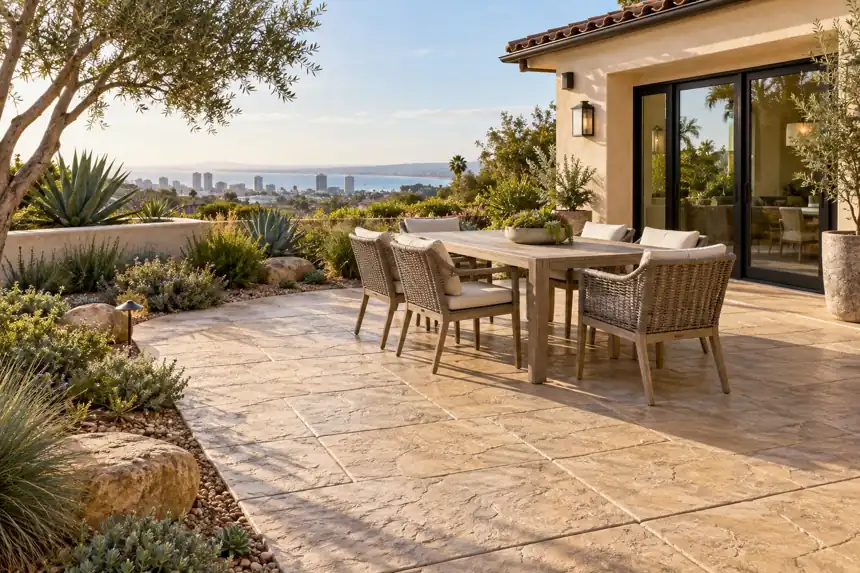
Stamped concrete starts as a poured slab. Color and texture are applied as it is finished, creating the appearance of stone, tile, or another pattern. The surface remains a continuous concrete installation with planned joints.
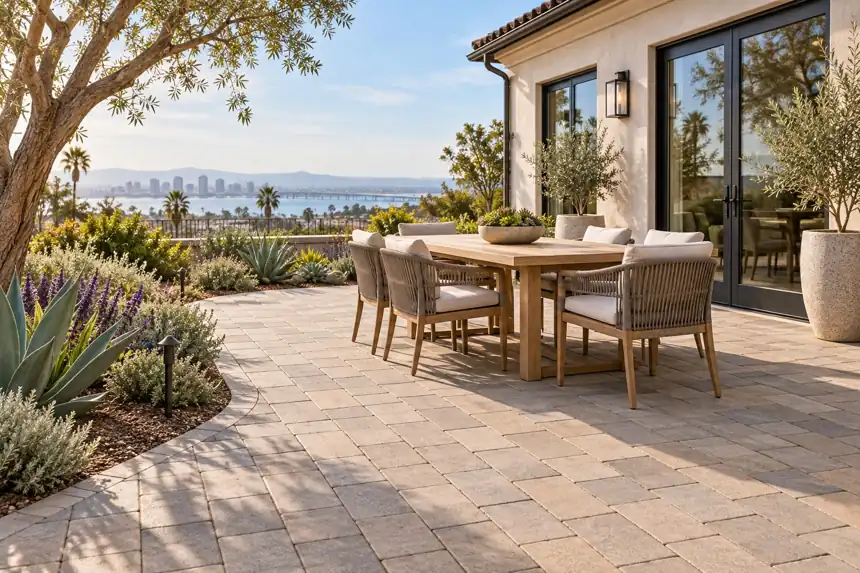
Interlocking concrete pavers are individual manufactured units placed over prepared bedding and a compacted base, with joint material and edge restraints. Natural stone and porcelain pavers are different products with different installation and pricing; this comparison focuses on concrete pavers.
| Decision point | Stamped concrete | Concrete pavers |
|---|---|---|
| Construction | Poured and patterned slab | Individual units on a designed base |
| Initial budget | Often lower for a basic comparable finish | Often higher; material and base choices vary |
| Localized repair | Patch may remain visible | Units may be lifted and reset |
| Typical upkeep | Cleaning and sealer care according to finish | Cleaning, joint and edge inspection; sealing depends on choice |
| Drainage | Surface slope carries water away | Conventional pavers also need drainage; permeable systems are specially built |
| Appearance | Continuous patterned finish with control joints | True unit edges and many layout choices |
How much do they cost in San Diego?
Published local contractor guides show a wide range. One San Diego masonry company lists installed stamped concrete patios at $12–$25 per square foot and concrete paver patios at $18–$30 per square foot, including basic grading and base preparation but excluding demolition and added features. Another local paver contractor gives a broader $22–$45 per square foot planning range for its paver work. These are those companies’ published estimates, not First Choice pricing or a quote for your address.
One local contractor’s published installed planning range.
Same contractor’s published range; another lists $22–$45.
For a hypothetical 400-square-foot patio, the first guide’s rates imply about $4,800–$10,000 for stamped concrete and $7,200–$12,000 for concrete pavers. That arithmetic only illustrates the published rates. Excavation, removing an old slab, access through a narrow side yard, drainage, steps, retaining walls, borders, and specialty materials can change a bid substantially. A driveway needs a vehicle-rated design and should be priced separately from a patio.
Ask whether the quoted rate covers the same demolition, soil preparation, drainage, edging, pattern, and cleanup. A low paver bid with little base preparation is not equivalent to a properly specified installation.
What happens below the surface matters
For stamped concrete, review excavation, subgrade preparation, slab specification, reinforcement when appropriate, control joints, curing, finish, and the planned slope. Joints help manage where shrinkage cracking occurs; they cannot promise a slab will never crack. The selected pattern should work with the joint plan rather than hide it in a way that compromises placement.
For pavers, the Concrete Masonry & Hardscapes Association describes a sequence that includes compacted subgrade, aggregate base, edge restraints, bedding, units, and joint material. Base design differs by soil and whether the surface carries pedestrians or vehicles. Poor preparation can lead to settlement or movement even when the pavers themselves remain intact.
How will you prepare this soil, manage the slope and runoff, and document the layers before they are covered? Request a written specification for the parts you cannot inspect after installation.
Which is easier to repair?
If a stamped slab cracks outside a planned joint or a buried line must be accessed, a repair can remain visible because a new patch may differ in color, stamp alignment, and weathering. The scope depends on the cause of movement and the size of the affected area.
Individual pavers can often be lifted, the underlying issue corrected, and the units reset. That makes a localized repair or future utility access more manageable. It does not make repairs free: excavating and rebuilding a failed base can still be significant work, and old or discontinued units may be hard to match. The CMHA maintenance guide covers identification and reinstatement of paver areas.
On either surface, ask why a dip or crack appeared before covering it. Surface work alone will not fix drainage or base failure.
Where does maintenance show up?
Stamped concrete needs routine cleaning and monitoring of its finish. Whether and when to reseal depends on the sealer, wear, exposure, appearance, and manufacturer guidance. A glossy finish can reveal wear and may need attention sooner than an owner expects. The American Concrete Institute lists decorative concrete best practices for sealing stamped surfaces.
Pavers need cleaning too. Inspect joints, edge restraints, weeds, staining, and any settling. Joint material may need maintenance; sealing can be chosen for a particular product and appearance but is not an automatic requirement for every conventional concrete paver installation. Trees and irrigation near either surface deserve attention because water and roots can affect the surrounding ground.
Do not treat either surface as maintenance-free. Ask the installer for a care plan tied to the exact product and finish in the quote.
Which feels cooler or less slippery?
Surface temperature depends on color, exposure, material, finish, and shade. A light-colored paver is not automatically cooler than every stamped concrete finish, and a dark paver can become hot in direct sun. Test actual samples in sun if bare feet are part of how you will use the patio.
Traction depends on texture and coatings. A smooth or glossy sealed surface can behave differently when wet than a textured finish. For a sloped walkway or poolside area, ask for a finish and sealer system suited to wet use and confirm how it will be maintained. A sample viewed under showroom lighting does not replace seeing the surface wet and in daylight.
Do pavers let rain soak through?
Ordinary interlocking pavers should not be assumed permeable. A permeable paver system is designed with suitable joints, open-graded bedding and base, and a site-specific water management plan. The CMHA construction guidance treats permeable interlocking concrete pavement as a distinct system.
A stamped slab sheds water across its surface, so grading and drainage are essential. Conventional pavers also need an appropriate slope and outlet. For either option, ask where runoff goes during a heavy storm and whether it affects the home, neighboring property, or a public area.
Patio, walkway, or driveway?
A backyard patio has different loads and details from a driveway. Vehicle-rated pavers need an appropriate structural base and edge support. A stamped concrete driveway needs a slab and joint plan suited to traffic and site conditions. Do not use a patio price or specification to compare driveway proposals.
For a San Diego driveway, examine the slope, garage threshold, existing drainage, and the connection to the street. Work on the driveway crossing, sidewalk, curb, or other public right-of-way can trigger a separate City of San Diego review. The City’s Information Bulletin 165 lists standard residential driveway removal, replacement, and new work under its minor right-of-way permit process. Requirements vary by scope and jurisdiction; confirm them for the actual address.
See First Choice’s San Diego driveway service for material options. For a patio within a broader backyard project, review the landscape design service.
Ask for the same scope in both bids
- Surface: exact area, concrete mix or paver product, pattern, color, borders, and finish.
- Groundwork: demolition, excavation depth, soil preparation, base materials, compaction, and disposal.
- Water: finished elevations, slope, drains, and where water will discharge.
- Build details: concrete thickness and joints, or paver base, bedding, edging, and joint material.
- Use: pedestrian or vehicle traffic, steps, pool proximity, furniture, and expected load.
- Aftercare: cleaning, sealing recommendations, maintenance responsibilities, and repair terms.
- Administration: applicable permits, site access, schedule, exclusions, and warranty terms.
A square-foot price without these details is difficult to compare. Ask the contractor to separate the surface choice from repairs to grading, drainage, or an old base so you can see which costs are shared by both options.
Choose for your site and priorities
Choose stamped concrete if you like a continuous patterned surface, the quoted design fits your budget, and you accept how joints, finish care, and future patches may look.
Choose concrete pavers if the unit pattern appeals to you and being able to lift and reset a localized area matters enough to justify the quoted installation scope.
Revisit the design if poor drainage, unstable ground, a steep slope, or a tight budget makes both bids depend on work that has not been specified yet.
Homeowner discussions repeatedly raise the same questions: whether concrete will crack, whether paver joints need upkeep, whether one quote is truly comparable, and what happens after years of use. Those experiences are useful prompts, but they cannot predict the outcome at your address. Start with an on-site assessment and written specifications.
Frequently asked questions
Is stamped concrete cheaper than pavers in San Diego?
Published local patio guides often list a lower initial range for basic stamped concrete. The final difference depends on the pattern, paver product, demolition, access, base, and drainage. Compare written bids for the same project rather than relying on a single rate.
Will stamped concrete always crack?
Concrete can crack as it cures or as the site changes. Proper preparation, curing, and planned joints help manage the risk and appearance but do not guarantee a crack-free slab. Ask where the joints will be before approving the pattern.
Can weeds grow between pavers?
Weeds can appear in joints when seeds and organic material collect there. The joint material and cleaning plan affect maintenance. An installer should explain how to maintain the chosen joint system.
Are pavers automatically permeable?
No. Conventional pavers and permeable interlocking pavers use different joint and base designs. Ask for a specifically designed permeable system if infiltration is a goal, and confirm whether it suits the property’s soil and drainage conditions.
Which material works better for a driveway?
Either can work when designed for vehicle use. Compare the vehicle-rated base, slab or paver specification, slope, edge details, and tie-in to the public driveway crossing. A patio specification is not sufficient for a driveway.
Can pavers be installed over existing concrete?
Sometimes, but only after checking the slab’s condition, elevation, drainage, door thresholds, and the proposed installation method. Covering a cracked or poorly drained slab without correcting the cause can carry the problem into the new surface.
Plan the whole project, from base to finish
Tell us whether you are planning a driveway, walkway, or patio. We can discuss the layout, drainage, materials, and scope for your San Diego property.
Related services: Driveway building · Landscape design
Installation and maintenance: CMHA construction guidance, CMHA maintenance guidance, permeable systems, and ACI decorative concrete sealing guidance. Local process: City of San Diego Bulletin 165. Pricing examples are from the named local contractors above and are not First Choice quotes. Homeowner questions informed by patio discussion and driveway discussion.