
The 13 Landscape Design Trends in Depth
Native and Climate-Adapted Planting Becomes the Default
Native plants have moved from a specialty look into mainstream design — the 2026 version is intentional: repeated masses, clear edges, and selected forms create a polished landscape while supporting local ecology. But "native" does not guarantee every plant thrives on every site; coastal exposure, inland heat, slope, drainage, and soil all matter. The UC Master Gardener Program for San Diego County recommends matching plants to similar natural conditions and grouping by water need.
Layered, Naturalistic Planting Replaces Isolated Specimens
Neatly spaced shrubs in bare mulch are giving way to layered plant communities — groundcovers, grasses, perennials, shrubs, and small trees overlapping for depth and movement. This is not an unmanaged meadow: it needs a clear framework of repeated species, intentional heights, defined paths, and room for mature size, with maintenance timing that respects fire risk and brush-management rules.
Lawns Become Smaller and More Purposeful
The 2026 question is not "lawn or no lawn?" but "what job does the lawn perform?" Turf is useful for play, pets, and gathering; when it is only a green gap, homeowners replace it with planting or usable space. Size a purposeful lawn around the activity and shape it for efficient irrigation. Synthetic turf removes grass irrigation but is not maintenance-free or automatically sustainable — heat, infill, drainage, and eventual replacement all deserve evaluation.
Water-Budget-First Design
Water efficiency is becoming a starting constraint, not an end-of-project upgrade — plant plan, soil, grading, and irrigation developed together. The City of San Diego has permanent restrictions: within its Public Utilities service area, potable landscape irrigation is limited to before 10 a.m. or after 6 p.m., runoff is prohibited, and watering during and within 48 hours after measurable rainfall is prohibited. Use hydrozones, separate trees from lower-rooted planting, and commission the system after planting.
Permeable Hardscape and Visible Water Management
Patios, paths, and driveways increasingly slow, spread, or infiltrate water rather than rushing it off-site — permeable pavers, gravel, planted swales, rain gardens, and dry-creek forms. Permeability is a system, not a surface label: soil infiltration, subbase, slope, sediment, foundations, and overflow all need consideration, and water should never be directed toward foundations, unstable slopes, or neighbors.
Defined Outdoor Rooms for Daily Living
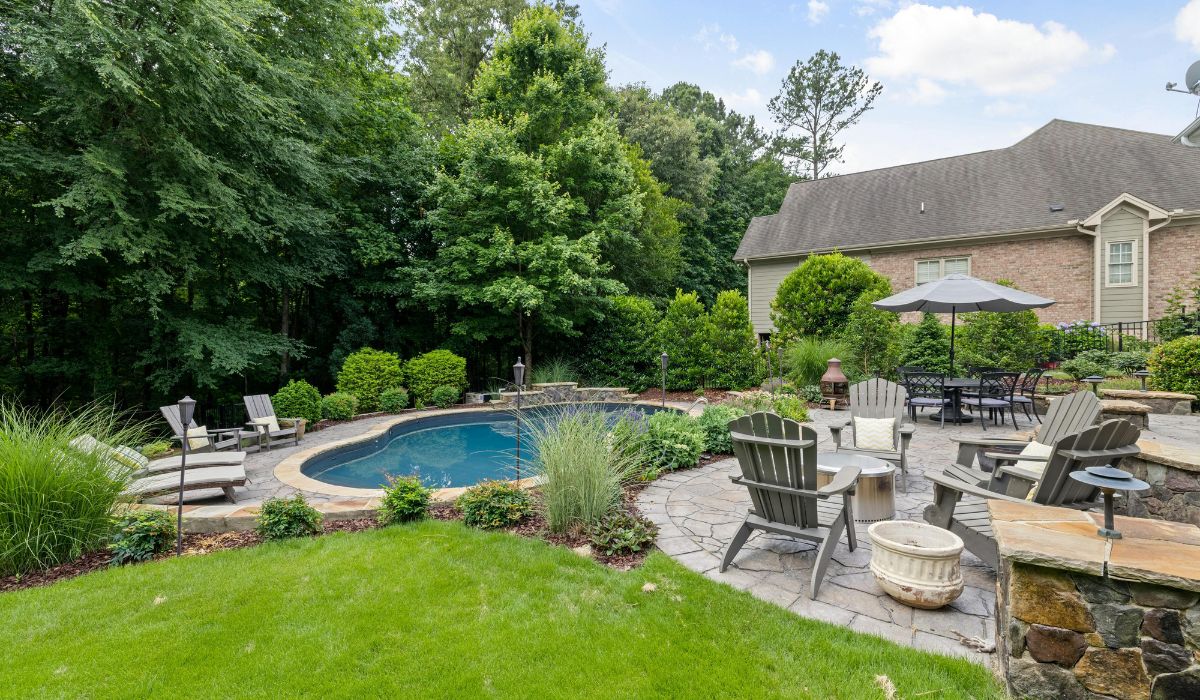
Homeowners are moving from one oversized patio toward comfortable, clearly defined zones for dining, lounging, cooking, play, and quiet time, connected by intuitive circulation that shares a material language with the house. A change in paving, a low wall, an overhead structure, or a planting edge can define a space without enclosing it. Our outdoor living construction services show how decks, covers, hardscape, and planting coordinate.
Quiet Wellness Gardens and Sensory Retreats
Outdoor wellness in 2026 is smaller and more personal — a shaded chair, reading nook, or low-stimulation garden can be more valuable than a large entertainment installation. Sensory design uses fragrance, texture, breeze, filtered light, and controlled water sound, while respecting sensory sensitivity: strong perfume, glare, and loud fountains are not relaxing for everyone.
Warm Earth Tones and Authentic Texture
Cool gray hardscapes are giving way to warmer palettes influenced by sand, clay, limestone, weathered wood, and rusted metal — a natural fit with San Diego's bright light and Mediterranean architecture. Authenticity does not require expensive natural stone everywhere; a restrained mix of durable pavers, stucco, stone accents, and metal works when you compare full-size samples outdoors.
Climate-Responsive Shade Becomes Part of the Plan
Shade determines whether an outdoor room is usable, and the 2026 approach combines living canopy and built structure rather than relying only on umbrellas added later. Trees provide cooling and scale, but species, roots, litter, water demand, and fire conditions must suit the site; a planned deck or patio cover provides predictable shade but may require permits and coordination with setbacks and drainage. Plot summer afternoon sun, winter light, and prevailing wind before placing anything.
Wildfire-Conscious Design Shapes the First Five Feet
For affected properties, wildfire-conscious landscaping is a design requirement, not an aesthetic. The City divides defensible space into Zone 0 (0–5 ft), Zone 1 (5–30 ft), and Zone 2 (30–100 ft). Zone 0 requirements apply to new structures in Very High Fire Severity Zones after February 28, 2026, and existing owners need to meet Zone 0 by February 28, 2027 — confirm current applicability for the property. Guidance emphasizes removing dead vegetation and combustible mulch and using concrete, gravel, or pavers in the first five feet. No plant is "fireproof."
Smart Landscape Lighting Becomes Quieter
Lighting is shifting from washing every surface with brightness to a restrained hierarchy: safe paths and steps, a few focal plants or walls, and low ambient light for outdoor rooms. Timers, dimming, and scenes make it adaptable, but glare, fixture longevity, wire routing, and replacement access matter as much as efficiency. Use exterior-rated fixtures and avoid shining light into neighbors' windows or drivers' sightlines.
Pollinator Habitat and Manageable Edible Landscapes
Homeowners increasingly want landscapes that do something — support pollinators, produce herbs or fruit, and create seasonal interest — but the practical 2026 version is manageable, not a high-maintenance urban farm. A small herb bed near the kitchen, one well-placed fruit tree, or a band of host and nectar plants adds daily value; choose fruit trees with suitable chill, heat, and pollination needs and use integrated pest management.
Phased Master Plans Replace All-at-Once Wish Lists
Instead of reducing quality across the whole yard, many homeowners create a master plan and install it in logical phases. The first phase should resolve work that is hard to change later — drainage, grading, underground utilities, primary circulation, retaining conditions, and major trees — with secondary planting, lighting, and furnishings following into reserved space.
What Is Fading in 2026?
Large lawns used only as visual filler are harder to justify under water, maintenance, and budget pressure.
Warmer stone, clay, and natural texture are returning. Gray still works as a neutral, but fully monochrome yards can feel flat in strong sun.
A yard of unrelated specimens looks busy and complicates irrigation. Repetition and compatible plant communities create stronger results.
Outdoor kitchen, fire pit, putting green, spa, and lawn do not all belong on every property. A few well-designed functions win.
Every landscape changes. Native planting, turf, gravel, pavers, and smart irrigation all need care — ask what, how often, and by whom.
How to Choose Trends for Your San Diego Property
Use this filter before approving any idea:
- Purpose: what daily or seasonal activity will it support?
- Site: does it suit sun, wind, soil, drainage, slope, and mature dimensions?
- Water: what is the establishment and long-term water demand?
- Fire: is the property in a fire-hazard zone, and where does the feature fall within defensible-space zones?
- Maintenance: what tasks, frequency, equipment, and cost will it require?
- Durability: how will the material or planting look after five years?
- Phasing: will it conflict with a later project or reserved utility route?
- Approval: do permits, HOA rules, easements, or environmental constraints apply?
A trend is worth using when it improves the landscape's performance and experience. If it adds upkeep or cost without a clear benefit, leave it out.
San Diego Water Rules and Landscape Compliance
The City of San Diego's permanent rules prohibit irrigation runoff and watering during or within 48 hours after measurable rainfall, and limit potable-water irrigation to before 10 a.m. or after 6 p.m. These apply within the City Public Utilities service area — homeowners served by another agency must check that provider. Larger new or rehabilitated landscapes tied to permits may also fall under local rules implementing California's Model Water Efficient Landscape Ordinance; have the project team confirm thresholds rather than relying on a summary.
Ask for these landscape documents on any significant project:
- Existing-conditions and site plan.
- Plant plan with botanical names, quantities, and mature sizes.
- Hydrozone and irrigation plan, plus water-budget documentation where required.
- Grading and drainage information.
- Hardscape materials and construction details.
- Lighting layout and fixture schedule.
- Defensible-space or brush-management plan where applicable.
- Establishment and long-term maintenance schedule.
The City lists water-conservation resources and rebates, but programs and eligibility change — check the property's water provider before removing turf or purchasing equipment.
A San Diego Plant Palette Should Be Site-Specific
These examples can start a conversation, but they are not a universal planting plan. Use botanical names on the final plan and verify nursery stock suits the property.
| Design role | Plants to evaluate with a local professional | Check before selection |
|---|---|---|
| Small tree / structural plant | Western redbud, selected toyon forms, appropriate oak species | Mature size, roots, litter, water, and fire-zone placement |
| Evergreen shrub structure | Lemonade berry, manzanita, ceanothus, coyote bush cultivars | Exposure, drainage, mature width, and maintenance |
| Seasonal color | California fuchsia, buckwheat, penstemon, monkeyflower, mallows | Bloom period, summer dormancy, irrigation, and pruning |
| Movement and texture | Deergrass and other site-appropriate native grasses | Dry-material management and defensible-space placement |
| Containers / compact spaces | Locally suitable native perennials and small shrubs | Container size, drainage, heat, and more frequent watering |
Natural Turf, Synthetic Turf, or Planted Landscape?
| Priority | Natural turf | Synthetic turf | Planted / groundcover |
|---|---|---|---|
| Active play | Often strong when maintained | Can support some uses; check heat and product system | Usually less suitable for repeated sports traffic |
| Irrigation | Ongoing | None for grass; cleaning may use water | Varies, often lower after establishment |
| Surface heat | Generally cooler | Can become very hot in sun | Depends on plant cover and soil |
| Ecology | Living soil, but limited habitat as monoculture | Minimal habitat, synthetic material | Can provide substantial habitat when well designed |
| Maintenance | Mowing, feeding, irrigation, repair | Cleaning, brushing, infill, eventual replacement | Weeding, pruning, mulch/soil, irrigation management |
| Best use | Purposeful lawn for play or gathering | Carefully evaluated specialty application | Most ornamental and habitat-oriented areas |
The correct answer can be a small natural lawn surrounded by water-wise planting, or no lawn at all. Avoid framing synthetic turf as the only water-efficient alternative.
First Choice Home Builders' Torrey Highlands landscape installation describes a broad, integrated scope — grading, irrigation, hardscape, planting, turf, and low-voltage lighting. That coordinated approach aligns with several 2026 trends because drainage, circulation, water management, and night use were considered together rather than added piecemeal. Explore what a coordinated plan can include through our San Diego landscape design services.
Questions to Ask a Landscape Designer in 2026
- How will the plant palette respond to this property's microclimates?
- Which plants are California native, climate-adapted, or neither?
- What will each plant's mature size be?
- How are irrigation hydrozones organized, and what does establishment watering require?
- How will drainage and overflow be handled?
- Is the property in a mapped fire-hazard area, and how does the design address Zones 0, 1, and 2?
- Which parts of the design require permits or HOA review?
- What maintenance is expected monthly, seasonally, and annually?
- How can the project be phased without duplicating work?
- Which products, plants, and allowances are specifically included in the proposal?
Design for 2026 — and the Years After It
The most valuable trends make a yard more comfortable, efficient, and resilient. First Choice Home Builders can evaluate your San Diego property, organize it into functional zones, and coordinate planting, hardscape, irrigation, lighting, and related construction into a buildable plan.
Frequently Asked Questions
What are the biggest landscape design trends for 2026?
The strongest trends are native and climate-adapted planting, layered naturalistic gardens, smaller purposeful lawns, smart irrigation, permeable hardscape, defined outdoor rooms, climate-responsive shade, restrained lighting, and wildfire-conscious design in affected areas.
Are drought-tolerant landscapes still popular in 2026?
Yes, but the conversation is becoming more precise. Homeowners are looking beyond a generic drought-tolerant label toward site-specific plants, hydrozones, healthy soil, efficient irrigation, and long-term maintenance. Newly installed low-water plants still require establishment irrigation.
What landscape colors are trending in 2026?
Warm earth tones such as sand, clay, tan, muted terracotta, warm limestone, and weathered metal are becoming more prominent. In planting, sunset colors and bold seasonal accents appear within green, silver, and gray-green structure.
Are native plants better than drought-tolerant non-native plants?
Native plants support regional habitat and are adapted to local conditions when correctly matched to the site. Some non-invasive plants from similar climates can also perform well. The best palette weighs habitat value, water, exposure, mature size, maintenance, and fire placement rather than relying on one label.
Is artificial turf still a landscape trend in 2026?
Interest continues, especially for low-irrigation, visually green spaces, but professionals debate its role. Heat, drainage, cleaning, product life, environmental effects, and replacement should be compared with natural turf, groundcovers, and planted alternatives.
How can I make a low-water yard look lush?
Use layered planting, repeat compatible plants in groups, include evergreen structure, vary leaf texture, and plan seasonal bloom. Improve soil and irrigation design rather than crowding plants. A low-water landscape can feel full without behaving like a high-water garden.
What is Zone 0 landscaping in San Diego?
Zone 0 is the first five feet around a structure, including attached decks and stairs. Current City guidance emphasizes removing combustible material and using ember-resistant hardscape. Requirements and dates depend on the property and current rules, so consult the City's defensible-space guidance before landscaping.
Does landscaping require a permit in San Diego?
Planting alone may not, but walls, grading, electrical work, plumbing or irrigation changes, structures, and work affecting environmentally sensitive or fire areas may require review. Water-efficient landscape requirements can apply to qualifying projects — confirm the full scope with the correct jurisdiction.
When is the best time to install native plants in San Diego?
The UC Master Gardener Program for San Diego County identifies the rainy season, generally November through April, as the preferred planting period for many native plants. Exact timing depends on species, site, irrigation, and weather.
Which 2026 landscape trends will last?
Water efficiency, climate-adapted plants, purposeful shade, drainage, defensible-space planning, and functional outdoor rooms address long-term needs. Particular colors, decorative features, and technology brands will change more quickly.